
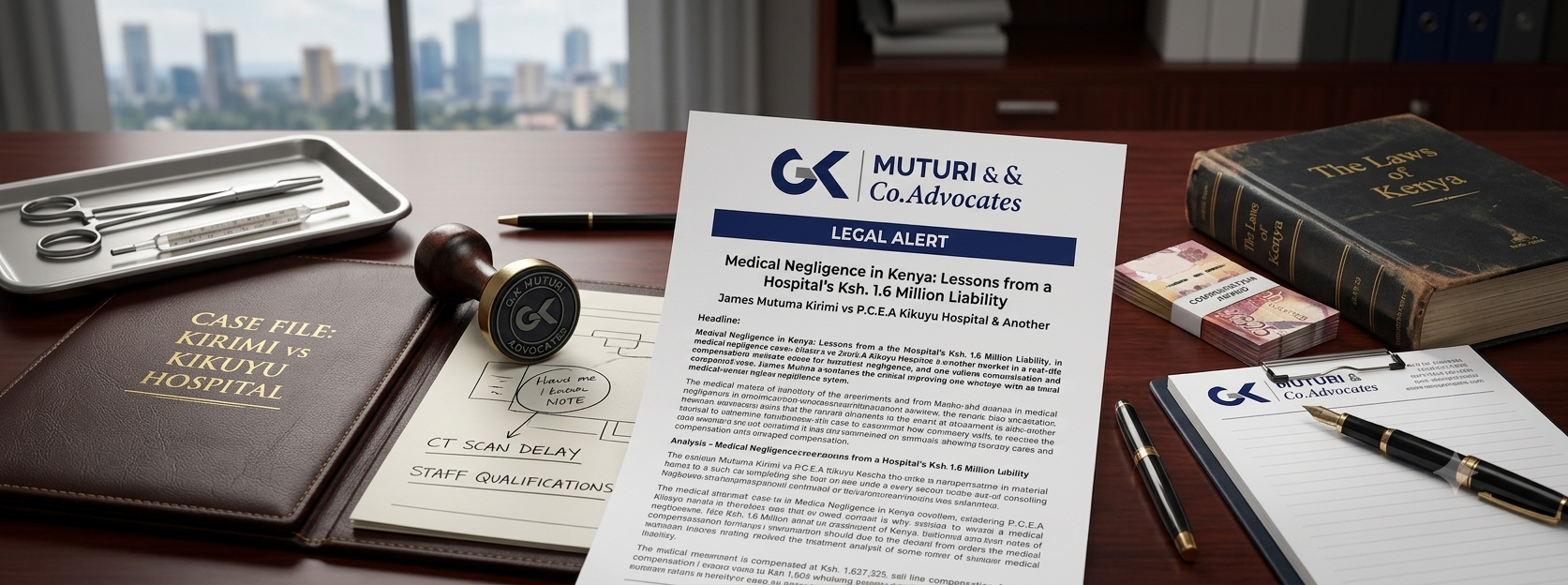
James Mutuma Kirimi (Suing as the Administrator of the Estate of Lucy Mwarania Kirim v P.C.E.A Kikuyu Hospital & Another [2017] eKLR — High Court of Kenya at Nairobi, Civil Case No. 392 of 2014
Following our recent podcast discussion on medical negligence and the duties owed by healthcare providers to their patients, we bring you this alert on a High Court decision that brings those principles to life. The case offers a timely reminder to hospitals, medical practitioners, and patients alike of the standard of care the law demands, and the consequences of falling short of it.
What Happened
Lucy Mwarania Kirimi, a 64-year-old retired teacher and active commercial farmer, was admitted to P.C.E.A Kikuyu Hospital for a minor surgery to correct a bone in her hand. While being prepared for the operation, she developed complications after being given local anaesthesia, suffered a cardiac arrest, and was resuscitated but fell into a coma. She was moved between several hospitals in search of better care and sadly passed away about three weeks later at Kenyatta National Hospital.
Her son, as administrator of her estate, sued the hospital for negligence. The matter had already been considered by the Medical Practitioners and Dentists Board, which found the hospital’s staff at fault and recommended compensation. When the hospital did not pay, the family took the matter to the High Court.
What the Court Decided
The Court found the hospital 100% liable for the death, holding that a hospital owes its patients the same duty of care as an individual doctor, and is responsible for the actions of its own staff. Several key failings stood out:
- The anaesthetist who actually administered the anaesthesia and made the critical treatment decisions was not called to testify, and there was no proof he was a qualified anaesthetist at the relevant time.
- The hospital could not produce evidence of its staff’s qualifications, despite being specifically asked to by the disciplinary Board.
- The resuscitation process was found deficient — the patient was taken off the breathing tube in the operating theatre despite her critical condition, and was not placed on mechanical ventilation at the Intensive Care Unit despite clear warning signs.
- A CT scan that could have confirmed the diagnosis and guided treatment was not ordered in good time.
The Court emphasised an important legal principle: where facts are especially within a defendant’s knowledge — such as what happens inside an operating theatre — the burden shifts to the defendant to prove that reasonable care was taken. The hospital was unable to meet that burden.
The Compensation Awarded
The Court awarded the family a total of Ksh. 1,637,325, made up as follows:
- Pain and suffering — Ksh. 100,000
- Loss of expectation of life — Ksh. 100,000
- Lost years (loss of future income/dependency) — Ksh. 570,320
- Special damages (proven medical and funeral expenses) — Ksh. 867,005
Notably, the Court declined to award amounts claimed without supporting receipts, underlining the importance of keeping proper documentation when pursuing such claims.
Why This Matters
- For hospitals and practitioners: Keep clear, complete records of staff qualifications and licences, and ensure proper hand-over and documentation of every procedure. Gaps in evidence can shift the outcome of a case entirely.
- For patients and families: A finding of negligence by a professional disciplinary body, such as the Medical Practitioners and Dentists Board, can carry real weight as evidence in a civil claim for damages.
- For anyone pursuing a claim: Keep every receipt and record of expenses incurred. The Court will only compensate losses that are actually proven.
- On liability: A hospital cannot distance itself from the mistakes of the staff it employs. If its staff are negligent, the hospital answers for it.
A Note on This Alert
This legal alert is provided for general information purposes only and is a simplified summary of a court decision. It does not constitute legal advice and should not be relied upon as such. Every case turns on its own facts, and the law may have developed since this judgment was delivered. If you or someone you know is affected by a similar situation, please seek professional legal advice before taking any action. Our contacts are as attached below
The full judgment, as published by Kenya Law, and an offline copy of this alert are linked below for your perusal should you wish to read it in detail respectively:
https://kenyalaw.org/akn/ke/judgment/kehc/2017/9459/eng@2017-09-29/source ( a copy of the original ruling )
Leave a Reply