
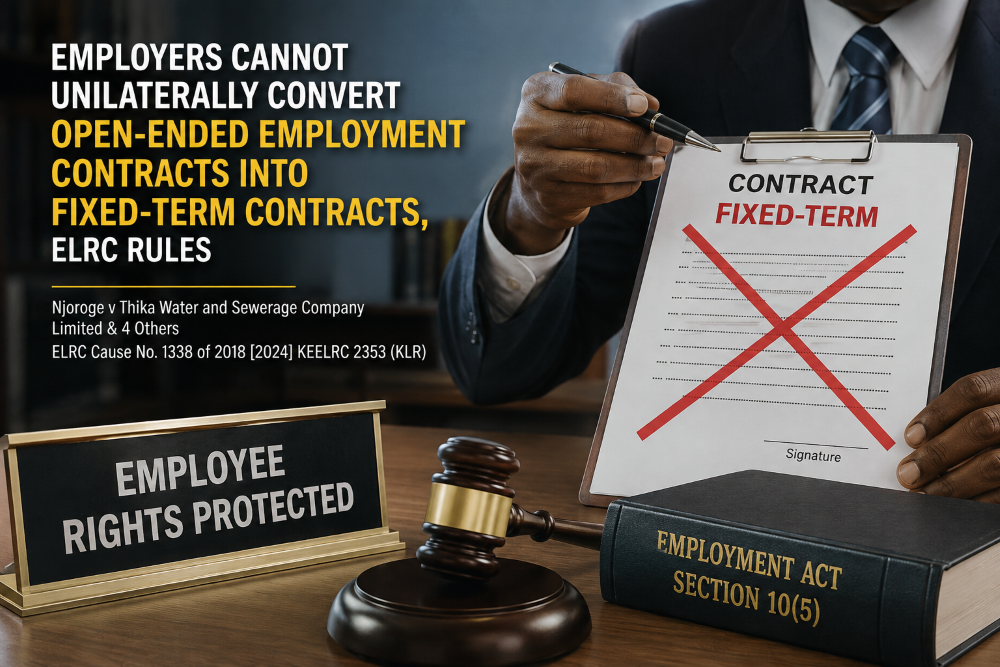
Njoroge v Thika Water and Sewerage Company Limited & 4 Others, Cause No. 1338 of 2018 [2024] KEELRC 2353 (KLR) – delivered 26 September 2024
Article by Gideon K. Muturi & Cynthia Cherono
BACKGROUND
The Employment and Labour Relations Court has reaffirmed an important protection for employees: an employer cannot unilaterally convert an existing indefinite employment contract into a fixed-term contract and later rely on the expiry of that contract to terminate the employee.
In Njoroge v Thika Water and Sewerage Company Limited & 4 Others, the Claimant had initially been employed on permanent and pensionable terms. Following his transfer to Thika Water and Sewerage Company Limited, those terms were preserved.
The Company later proposed a three-year fixed-term contract, which the Claimant declined to sign. Despite this, the Company treated his employment as fixed-term and, upon the alleged expiry of the three years, considered his employment terminated. The Court disagreed
KEY FINDINGS
- An indefinite contract cannot be converted into a fixed-term contract unilaterally.
Where an employee’s existing terms are indefinite, an employer must demonstrate a valid contractual variation before treating the employment as fixed term.
- Consultation is required before changing the duration or form of a contract.
Section 10(5) of the Employment Act requires an employer seeking to alter the form or duration of a written contract to consult the employee and record the agreed variation in writing.
- An unsigned contract does not change the existing employment relationship.
The proposed three-year contract had never been executed by the Claimant. It therefore did not replace his existing indefinite contract.
- An employer cannot manufacture an “expiry” where no valid fixed term existed.
Because the alleged fixed-term contract had never validly replaced the Claimant’s indefinite contract, there was no fixed term capable of expiring. The purported termination was therefore unlawful.
OUTCOME
In Njoroge, the Court found that the Company’s treatment of the Claimant’s contract as having expired constituted unlawful termination. The Court further found that the employer’s conduct amounted to constructive termination and violated the Claimant’s constitutional right to fair labour practices under Article 41 of the Constitution
WHAT THIS MEANS FOR EMPLOYERS
Employers seeking to change an employee’s existing contractual terms should:
- Consult the affected employee before changing the form or duration of the contract;
- Obtain clear agreement to the proposed variation;
- Document and execute the agreed variation; and
- Maintain proper employment records supporting the contractual terms relied upon.
READ THE FULL JUDGMENT
- A copy of the full ELRC judgment is attached to this alert for members of the public who wish to read the complete decision. It can also be accessed online at the link below:
- https://kenyalaw.org/akn/ke/judgment/keelrc/2024/2353/eng@2024-09-26
- To get this Alert in a PDF offline copy kindly see below;
https://gkmuturi.ke/law/wp-content/uploads/2026/08/legal-alertWebsite-ready.pdf
| DISCLAIMER This alert is provided for general information purposes only and does not constitute legal advice. It should not be relied upon as a substitute for tailored legal counsel. For advice specific to your circumstances, please contact us using the details below. |

G.K MUTURI & CO. ADVOCATES
Leave a Reply